
At last week's Rotary meeting we heard from speaker Angela Miller. Angela has been working in the education sector for the past 24 years in a number of different roles from teacher, Resource Teacher of Learning and Behaviour (RTLB), Curriculum Leader of English and Deputy Principal to educational consultant, literacy facilitator, tutor at Victoria University and researcher.
She has recently completed her PhD on Effective Principal Practice in Low Socio Economic Schools for Educational Success.
Prior to this Angela had been working to support school leadership teams and teachers in a facilitators role, firstly in extending high standards and schooling improvement projects and most recently in literacy development and leadership. She has worked in a variety of educational institutions both at home and abroad for a number of years in countries including, Australia, England and Colombia. The following are some notes from Angela's talk.
She has recently completed her PhD on Effective Principal Practice in Low Socio Economic Schools for Educational Success.
Prior to this Angela had been working to support school leadership teams and teachers in a facilitators role, firstly in extending high standards and schooling improvement projects and most recently in literacy development and leadership. She has worked in a variety of educational institutions both at home and abroad for a number of years in countries including, Australia, England and Colombia. The following are some notes from Angela's talk.
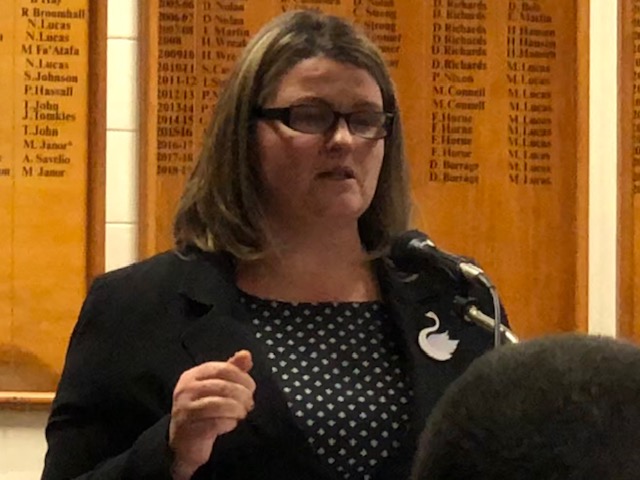
Principal leadership in a Primary School setting. Angela was concerned by the relationship between of Low Socio-economic Environment (LSE) and learning. Non achievers were also not achieving at NCA. Greater education achievement means less disappointment later in life and less burden on the social welfare system due to incarceration or welfare costs.
Angler’s research focus was on :
- Context – Impact of context.
- Practice – What I learnt about Leadership. Leadership doesn’t exist in one person.
- Change – What change had occurred? What does that mean for organisations like Rotary?
Patterns in Leadership Practice.
- Shaping the Network – connectedness of the school network – bounding of the leadership stretched outside of the school environment – social circumstances don’t always allow families to participate – membership of network, levels of engagement and sharing power.
- Facilitating Engagement – internodness – safety of environment and readily resolving any issues (e.g. removing graffiti) – bulling minimised – cultural awareness – flexible structures – measures of success – resourcing for learning.
- Creating reciprocal arrangements – self generations – having a clear shared vision – ways of working, collaboration, inclusive – like family.
- Confronting inequality – sustainability – deeply held philosophy held by principal leader – a political voice (awareness) – reject defeatist theorising – creative resourcing – support health needs (facilitating access to health services that are already available).
The impact of Context. Critical points for consideration:
- Professional Learning Development (PLD)
- Resourcing
- Community school relationships (it takes a village to raise a child)
So What?
- Community school relationships – create long term relationships with schools, develop reciprocity, support school reputation, encourage a wider positive community narrative.
- Support schools to connect with each other (and celebrate their points of difference).
- PLD – involve in Science and ICT – support schools to deliver as wide a curriculum as possible.
- Resourcing – principals spend way too much time trustee’s matters. May be a conflict being a lead learner and a manager of school – consider offering expertise.
- Support Fundraising efforts – e.g. take on grant applications – transportation to activities is a burden that many low socioeconomic schools cannot manage.
Conclusion. Under achievement is endemic and beyond the school walls, principals are not magic workers. [ through conversations action happens ]
Questions led to a discussion of how Rotary might move forward with this knowledge and Angela offered to participate in a small working group to discuss further.